Friday, June 13, 2014

Day 3 - Mexico City

Sunday morning! Some roads were closed in the morning for people to cycle and jog. The weather was cooling. If I had time, I would love to cycle around and enjoy the cool weather and sun. 


Wiki: "Opened in 1964 by President Adolfo López Mateos, the museum has a number of significant exhibits, such as the Stone of the Sun (depicted below), giant stone heads of the Olmec civilization that were found in the jungles of Tabasco and Veracruz, treasures recovered from the Maya civilization, at the Sacred Cenote at Chichen Itza, a replica of the sarcophagal lid fromPacal's tomb at Palenque and ethnological displays of contemporary rural Mexican life. It also has a model of the location and layout of the former Aztec capital Tenochtitlan, the site of which is now occupied by the central area of modern-day Mexico Cityitself.
The permanent exhibitions on the ground floor cover all pre-Colombian civilizations located on the current territory of Mexico as well as in the southwestern states of the USA. They are classified as North, West, Maya, Mexican Gulf, Oaxaca, Mexico, Toltec, and Teotihuacan. The permanent expositions at the fist floor show the culture of Native American population of Mexico since the Spanish colonization."

It is a really good museum to understand the pre-Colombian civilization - Aztec and Mayans etc.. 


One of the exhibits. 
The impermanence of life.


This is an ornament used by a royalty or a very rich lady.
It is made of shell and was supposed to be very very expensive back in those days (in the inner part of Mexico). The value of Scarcity. 

This reminded me of the true value of Diamond, which is quite abundant and not as scarce as most people think. The scarcity value was artificially created by De Beers who was hoarding the Diamonds. Somehow, many people still pay lotsa money for this shinny stone.  

Also remind myself not to fall prey to marketing campaign and gimmicks.


Map of the different monuments and artifacts from various region in Mexico.
I was quite ignorant about Mexico history, not realizing that they were made up by various civilizations in different regions coexisting together.


Artifact


Reconstruction of one of the monuments.
Interesting Art.


Olmeca-Xicalanca - Cacaxtla bird man mural. Interesting too!


Unique Culture.


Stone of the Sun (Aztec "Calendar").

Wiki: "The Aztec Calendar Stone, Sun Stone, Piedra del Sol, or Stone of the Five Eras is a late Post-Classic Mexicasculpture housed in the National Anthropology Museum in Mexico City, and is perhaps the most famous work of Aztec sculpture.[1] The stone is 358 centimetres (11.75 ft) in diameter and 98 centimetres (3.22 ft) thick, and it weighs about 24 tons.[2] Shortly after the Spanish Conquest, the monolithic sculpture was buried in the Zócalo, or main square of Mexico City. It was rediscovered on December 17, 1790 during repairs on the Mexico City Cathedral.[3][4] Following its rediscovery, the Calendar Stone was mounted on an exterior wall of the Cathedral, where it remained until 1885."


Stone of the Sun (Aztec "Calendar").

There was a prophecy about the end of the world in Dec 2012 due to the end of the Malayan Calender. We have heard about more prophecy about end of the world, judgement day etc... but we are still all around. Many people believed in these cults and sold their entire property to support the propagation of all these nonsense. Can't emphasize the need to have an independent critical mind - always questioning and querying.

The irony for this end of the world Malayan Prophecy is that it is based on an Aztec Calendar (not a Malayan one).


Looks Japanese.


Interesting


Intricate Mask


Beheaded for sacrificial purposes.


Hierarchy in the ancient civilization.
  

Beautiful Art


One of the rulers was buried with these jades (which would bring him to paradise or something like that)


Beautiful & Colour Art piece.

Some thoughts after visiting the Museum:

1. All the possessions don't belong to us, we are just a temporary keeper. Look at the gold and ornaments, it used to belong to the kings/rich, but it belongs to the Museum now. So don't be too attached to physical items.

2. Mexico has many minority tribes and cultures. We should celebrate the diversity of our world instead of discriminating due to differences.


Polanco - the upscale area in Mexico City


Rolls Royce showroom in Polanco


Nice cafe in Polanco

Angel of Independence

Wiki: "The Angel of Independence (Spanish: El Ángel de la Independencia), most commonly known by the shortened nameEl Ángel and officially known as Monumento a la Independencia, is a victory column on a roundabout over Paseo de la Reforma in downtown Mexico City.
El Ángel was built in 1910 to commemorate the centennial of the beginning of Mexico's War of Independence. In later years it was made into a mausoleum for the most important heroes of that war. It is one of the most recognizable landmarks in Mexico City, and it has become a focal point for both celebration or protest. It resembles the July Column inParis and the Berlin Victory Column in Berlin."


A random altar in the middle of city near the Angel of Independence Statue.
Another evidence that Mexicans are very spiritual or superstitious.


Museo del Templo Mayor 

Wiki: "The Templo Mayor[1] was one of the main temples of the Aztecs in their capital city of Tenochtitlan, which is now Mexico City. Its architectural style belongs to the late Postclassic period of Mesoamerica. The temple was called the huei teocalli [ˈwei teoˈkalːi][2] in the Nahuatl language and dedicated simultaneously to two gods, Huitzilopochtli, god of war, and Tlaloc, god of rain and agriculture, each of which had a shrine at the top of the pyramid with separate staircases. The temple, measuring approximately 100 by 80 m (328 by 262 ft) at its base, dominated a Sacred Precinct.[3] Construction of the first temple began sometime after 1325, and it was rebuilt six times after that. The temple was destroyed by the Spanish in 1521.[4] The modern-day archeological site lies just to the northeast of the Zocalo, or main plaza of Mexico City, in the block between Seminario and Justo Sierra streets.[5]
The site is part of the Historic Center of Mexico City, which was added to the UNESCO World Heritage List in 1987."

Aztec Ruin in the midst of the city.
Apparently, there was modern building over the ruin, and then, they decided to remove the building and restore the ancient Aztec building.

Model of the Aztec Monument.


Lotsa people


Offerings (outside the church)


After service...


After service...

=)

Thursday, June 12, 2014

Day 4 - Chichen Itza & Cancun (Mexico)

The previous night, we took a flight from Mexico City to Cancun. The flight was delayed and it was chaotic in the airport. I made friends with the 2 young siblings (around 20year old) who were sat beside me. It was tough to communicate as they could barely speak english (and I speak no spanish). It was fun though, especially, they were really really excited about going to Cancun. Excitement is contagious. =)

Our flight was delayed and we managed to meet SM (who flew in via New York) to join us in Cancun. It is always a special feeling to meet someone familiar in a foreign land (half a globe away). 

My first impression of Cancun is that it looks like United States. Big road and clean roads on the touristy stretch. We rented a car in Cancun (read lotsa horrendous stories), and subsequently, my credit card details had been misused and I suspect it is the leakage by  the car rental company (obviously, I do not have any proof). 

Chichen Itza

Wiki: "Chichen Itza at the mouth of the well of the Itza") was a large pre-Columbian city built by the Maya people of the Post Classic. The archaeological site is located in the municipality of Tinum, in the Mexican state ofYucatán.[3]
Chichen Itza was a major focal point in the northern Maya lowlands from the Late Classic (c. AD 600–900) through the Terminal Classic (c.AD 800–900) and into the early portion of the Early Postclassic period (c. AD 900–1200). The site exhibits a multitude of architectural styles, reminiscent of styles seen in central Mexico and of the Puuc and Chenes styles of the northern Maya lowlands. The presence of central Mexican styles was once thought to have been representative of direct migration or even conquest from central Mexico, but most contemporary interpretations view the presence of these non-Maya styles more as the result of cultural diffusion.
Chichen Itza was one of the largest Maya cities and it was likely to have been one of the mythical great cities, orTollans, referred to in later Mesoamerican literature.[4] The city may have had the most diverse population in the Maya world, a factor that could have contributed to the variety of architectural styles at the site.[5]
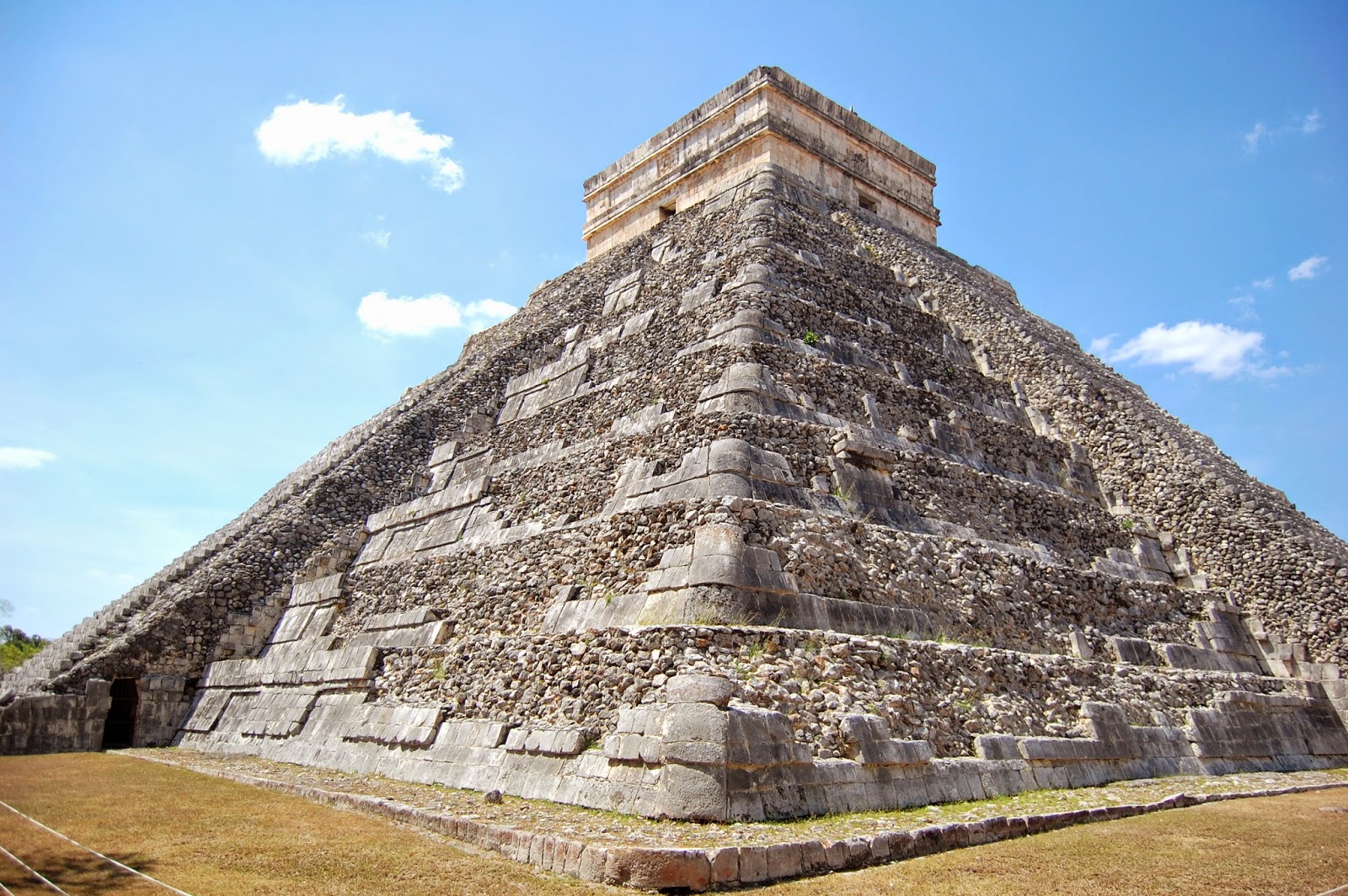
El Castillo, also known as the Temple of Kukulcan

(Prior to the trip, I was thought that this temple is Chichen Itza. Actually, Chichen Itza is the a big area with many ruins, and this temple is one of them)

Wiki: "El Castillo (Spanish for "the castle"), also known as the Temple of Kukulcan, is a Mesoamerican step-pyramid that dominates the center of the Chichen Itza archaeological site in the Mexican state of Yucatán. The building is more formally designated by archaeologists as Chichen ItzaStructure 5B18.
Built by the pre-Columbian Maya civilization sometime between the 9th and 12th centuries CE, El Castillo served as a temple to the god Kukulkan, the Yucatec Maya Feathered Serpent deity closely related to the godQuetzalcoatl known to the Aztecs and other central Mexican cultures of thePostclassic period.
The pyramid consists of a series of square terraces with stairways up each of the four sides to the temple on top. Sculptures of plumed serpents run down the sides of the northern balustrade. During the spring and autumn equinoxes, the late afternoon sun strikes off the northwest corner of the pyramid and casts a series of triangular shadows against the northwest balustrade, creating the illusion of a feathered serpent "crawling" down the pyramid. Each of the pyramid's four sides has 91 steps which, when added together and including the temple platform on top as the final "step", produces a total of 365 steps (which is equal to the number of days of the Haab' year).[1]
The structure is 24 m high, plus an additional 6 m for the temple. The square base measures 55.3 m across."
Serpent on the bottom left & its body is made up by a series of the triangles (diagonally from the bottom to the top)


Chichen Itza - my last wonder.

About 4 year ago, I was wondering if I could complete the new 7 wonders of the world, as these places are scattered all around the world. Back then, I have only visited 2 sites. Slowly, I ticked off the checklist every year. 

Below are sites that I visited in chronological order:

1998, 2002 & 2005: The Great Wall of China in Beijing
2007: Taj Mahal in Agra India
2010: Petra in Jordan
2011: Christ the Redeemer in Rio de Janeiro, Brazil
2012: Machu Picchu in Cusco, Peru
2013: Colosseum in Rome, Italy
2014: Chichen Itza in Yucatan, Mexico

I am really really grateful that I have the opportunity to travel the world.

The "soccer" field for the ancient Mayan.

Gotta go through this tiny hole to score.

There was speculation of human sacrificial for the losing team: http://en.wikipedia.org/wiki/Mesoamerican_ballgame#Human_sacrifice

"The association between human sacrifice and the ballgame appears rather late in the archaeological record, no earlier than the Classic era.[52] The association was particularly strong within the Classic Veracruz and the Maya cultures, where the most explicit depictions of human sacrifice can be seen on the ballcourt panels—for example at El Tajin (850–1100 CE)[53] and at Chichen Itza (900–1200 CE)—as well as on the well-known decapitated ballplayer stelae from the Classic Veracruz site of Aparicio (700–900 CE). The Postclassic Maya religious and quasi-historical narrative, the Popol Vuh, also links human sacrifice with the ballgame (see below).
Captives were often shown in Maya art, and it is assumed that these captives were sacrificed after losing a rigged ritual ballgame.[54] Rather than nearly nude and sometimes battered captives, however, the ballcourts at El Tajin and Chichen Itza show the sacrifice of practiced ballplayers, perhaps the captain of a team.[55] Decapitation is particularly associated with the ballgame—severed heads are featured in much Late Classic ballgame art and appear repeatedly in the Popol Vuh. There has even been speculation that the heads and skulls were used as balls"

Beautiful!!


Un-restored side of the Pyramid.

Astrology Center of the Mayan. Impressive!

Nice Architecture


Symmetrical.

There is a "bird chirping" echo if you clap your hands a few times. Quite interesting.


The ability to calculate and build such a structure shows that it is a very developed civilization. According to the guide, this place was abandoned as the surrounding resources have been used up and the water source was depleting.


Ik Kil Cenote

Wiki: "Ik Kil is a well known cenote outside Pisté in the Municipality of TinúmYucatánMexico, It is located in the northern center of the Yucatán Peninsula and is part of the Ik Kil Archeological Park near Chichen Itza. It is open to the public for swimming and is often included in bus tours.

The cenote is open to the sky with the water level about 26 metres (85 ft) below ground level. There is a carved stairway down to a swimming platform. The cenote is about 60 metres (200 ft) in diameter and about 40 metres (130 ft) deep.[1] There are vines which reach from the opening all the way down to the water along with small waterfalls. There are black catfish which swim in the cenote. Cenote Ik Kil is sacred to the Mayans and the Mayans used this cenote for both relaxation and ritual services."

Lotsa tourists, but it is very nice. A sinkhole with water in the middle of nowhere.


Vines


My first time swimming in a sink hole (Cenote). 
Quite a cool experience. =)